The Delmarva fox squirrel spent decades on the endangered list before a patchwork of careful habitat management bought it back.
Delisted in 2015, which makes it the counter-case sitting next to the losses.
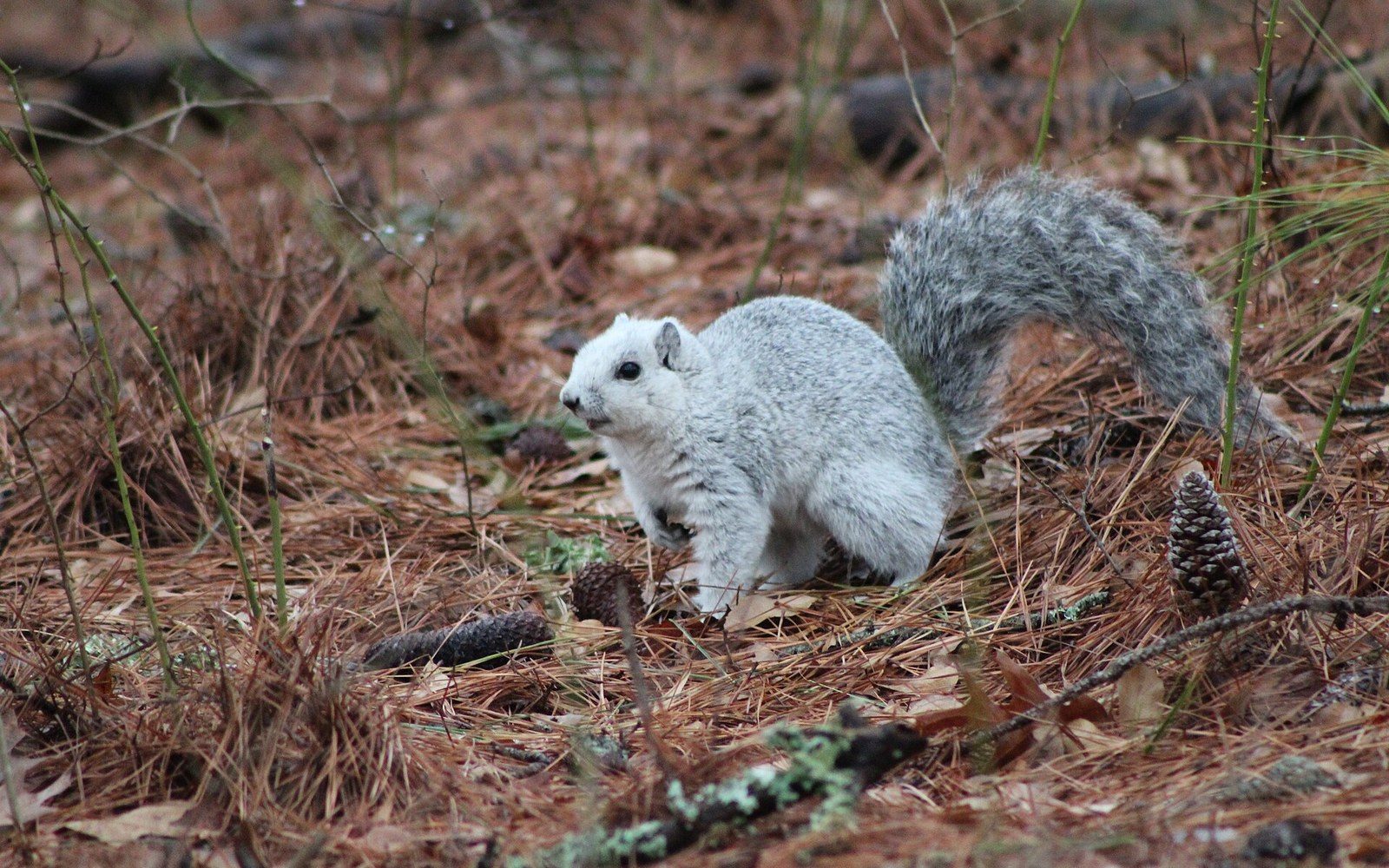
Photo: Delmarva Fox Squirrel (Sciurus niger cinereus) · Wikimedia Commons
A Big Squirrel in a Shrinking Forest
The Delmarva fox squirrel is hard to mistake for anything else. At roughly twice the weight of a gray squirrel and clothed in pale silver-gray fur with white feet, it moves with a deliberateness that matches its size — more loping gallop than nervous scatter. It is a creature of the coastal plain, historically ranging across the Delmarva Peninsula and into southern Pennsylvania, but by the middle of the twentieth century that range had collapsed to a handful of fragmented patches on Maryland's Eastern Shore, with Virginia's share of suitable habitat largely gone.
The species was first listed as endangered in 1967 and carried into the Endangered Species Act when it was enacted in 1973, though its trouble predated the listing by generations. The Delmarva fox squirrel requires a specific kind of forest: mature, open-canopied woodland with minimal shrub understory, where it can see and move across the ground to reach the mast crops — acorns, hickory nuts, pine seeds — that sustain it. Old-growth pine and mixed hardwoods once covered wide swaths of the peninsula. Logging, fire suppression, and conversion to agriculture fragmented that cover until the squirrel's remaining parcels were too small and too isolated to support a stable metapopulation.
Recovery timeline
Chronology
1967Listed as endangered under the predecessor Endangered Species Preservation Act; carried into the Endangered Species Act in 1973
Mid-20th centuryRange already collapsed to fragments on Maryland's Eastern Shore before listing
1960s–2000sTranslocation program moves squirrels to Chincoteague NWR and other sites; prescribed fire and timber management expand across refuge lands
2015Delisted by U.S. Fish and Wildlife Service; post-delisting monitoring plan enacted
Recovery did not hinge on a single dramatic intervention. It was cumulative and slow: decades of timber management that favored open canopy conditions, prescribed fire to suppress the shrub layer, and a translocation program that moved animals from stronghold populations into areas of restored habitat. The Chincoteague National Wildlife Refuge received squirrels from Maryland and in time developed a self-sustaining population, which made it one of the anchoring sites in the recovery story along Virginia's barrier island and coastal landscape.
Federal refuges drove much of the effort. The partnership between the U.S. Fish and Wildlife Service, state wildlife agencies, and private landowners who agreed to manage timber in squirrel-compatible ways is the structural reason recovery worked. Virginia's Eastern Shore, where pines and mixed woodlands border agricultural fields, provided workable real estate once the management framework was in place. The species responded. Surveys documented expanding occupancy in areas that had been empty for years.
Shelters, walls and culverts built in the 1930s still carry the public through these places.
The 2015 delisting by the U.S. Fish and Wildlife Service was the formal recognition that the population had crossed the thresholds set in the recovery plan: sufficient numbers, across sufficient area, with sufficient habitat management in place to give confidence of persistence without the Act's full protective apparatus. A post-delisting monitoring plan, standard practice, required continued tracking to confirm the recovery held.
What It Tells You About Recovery
The Delmarva fox squirrel is the counter-case to the losses that crowd the same list. It did not recover because its habitat regenerated on its own. It recovered because people decided on specific management outcomes and executed them over multiple decades with the patience that large, slow-reproducing mammals require. Fox squirrels do not move quickly across fragmented landscapes; they needed the habitat to come to them, or to be carried there. Translocation records held by the USFWS document the movement of animals between sites — a program that required coordination among agencies and landowners who might otherwise have had no reason to communicate.
What the habitat looks like
Mature, open-canopied forest
pine or mixed pine-hardwood with little shrub understory
Ground visibility matters: squirrels cross open ground to reach mast; dense shrubs block movement
Fire-maintained: without periodic fire or active management, succession closes the canopy and thickens the understory
There is a lesson in what kind of forest the squirrel demands. Open-canopied, fire-maintained pine and mixed woodland is not what unmanaged succession produces on the coastal plain. Left alone, these forests close in. The shrub layer thickens. The ground visibility that fox squirrels need to cross safely between trees disappears, and so does the squirrel. Managing for the species means managing actively, which means fire, selective harvest, and continued attention — not a reserve set aside and left. The Virginia Department of Wildlife Resources has been part of the post-delisting monitoring network, maintaining surveillance on a species that, by statute, no longer requires it but that land managers are not yet ready to stop watching.
The Delmarva fox squirrel is not out of the woods in any casual sense. Its range remains a fraction of what it once was, and the private lands on which many animals live are only as well managed as the agreements that govern them. But it is alive in places that were empty a generation ago, which is the definition of a recovery.