Reclaimed strip-mine land in far southwest Virginia now carries a herd that hasn't been here since the eighteenth century.
Reclaimed mine land is why the range is so precisely bounded. The grass is where the mining stopped.
Why Buchanan County, and Why Mine Land
Eastern elk — the subspecies that ranged through the Appalachians before European settlement — were gone from Virginia by the late 1700s, hunted out as the frontier moved west. The animals that replaced them ecologically were deer, which tolerate fragmentation and edge habitat in ways elk do not. For two centuries, the big ungulate was simply absent.
The return was deliberate and geographically precise. Beginning in 2012, the Virginia Department of Wildlife Resources partnered with the Rocky Mountain Elk Foundation and several coal companies to release elk trapped in Kentucky onto reclaimed surface-mine land in Buchanan County, in far southwestern Virginia. By 2020 roughly 250 animals had been released in multiple cohorts, and the population had begun to grow on its own. As of the agency's most recent reporting, the herd numbers in the hundreds, with the count fluctuating as the population expands and ranges shift.
Key numbers
2012
first elk released in Buchanan County
Source animals trapped in Kentucky, which has the largest eastern elk herd in the country
Approximate 250 animals released across multiple cohorts through 2020
Cervus canadensis nelsoni
Rocky Mountain elk, the subspecies used as surrogate
Eastern elk (Cervus canadensis canadensis)
the original subspecies, extinct
Built 1930s.
The choice of location was not incidental. Buchanan County sits in the Cumberland Plateau physiographic province, a landscape shaped for a century by coal extraction. When surface mines are closed and reclaimed under federal law — graded flat, seeded, and left — they produce broad, open grasslands edged by young forest. That structure, uncommon almost everywhere else in the densely wooded southern Appalachians, is almost exactly what elk require: room to graze, sight lines to detect predators, and woodland cover for thermal shelter and calving. The herd's range is so tightly bounded to Buchanan and immediate neighboring areas because that is where the habitat exists. Cross a ridgeline into the intact hardwood forest and elk thin out immediately; the topography and the land cover together draw the map.
What Reclamation Produced
The Surface Mining Control and Reclamation Act of 1977 required that disturbed land be returned to its approximate original contour and productive use. In practice, across much of Appalachia, that produced large grassy benches — "mine benches" in local usage — that coal companies seeded with fescue and clover. For decades these areas were managed mainly for erosion control and legally compliant closure. The elk reintroduction turned them into functional wildlife habitat retroactively, a second-order benefit nobody planned for in 1977.
Ridge behind ridge, and every line a different air temperature. Elevation is what sorts the animals in this state.
Elk grazing on reclaimed mine land at these elevations also interacts with the forest edge in ways that affect plant community composition — browsing young woody stems, keeping openings from reverting to scrub — which means the herd is now doing ecological work, not just occupying space. Virginia's portion of the reintroduction is part of a larger Appalachian effort; Kentucky's herd, established years earlier and drawn from the same Rocky Mountain stock, numbers in the thousands and provided the source animals.
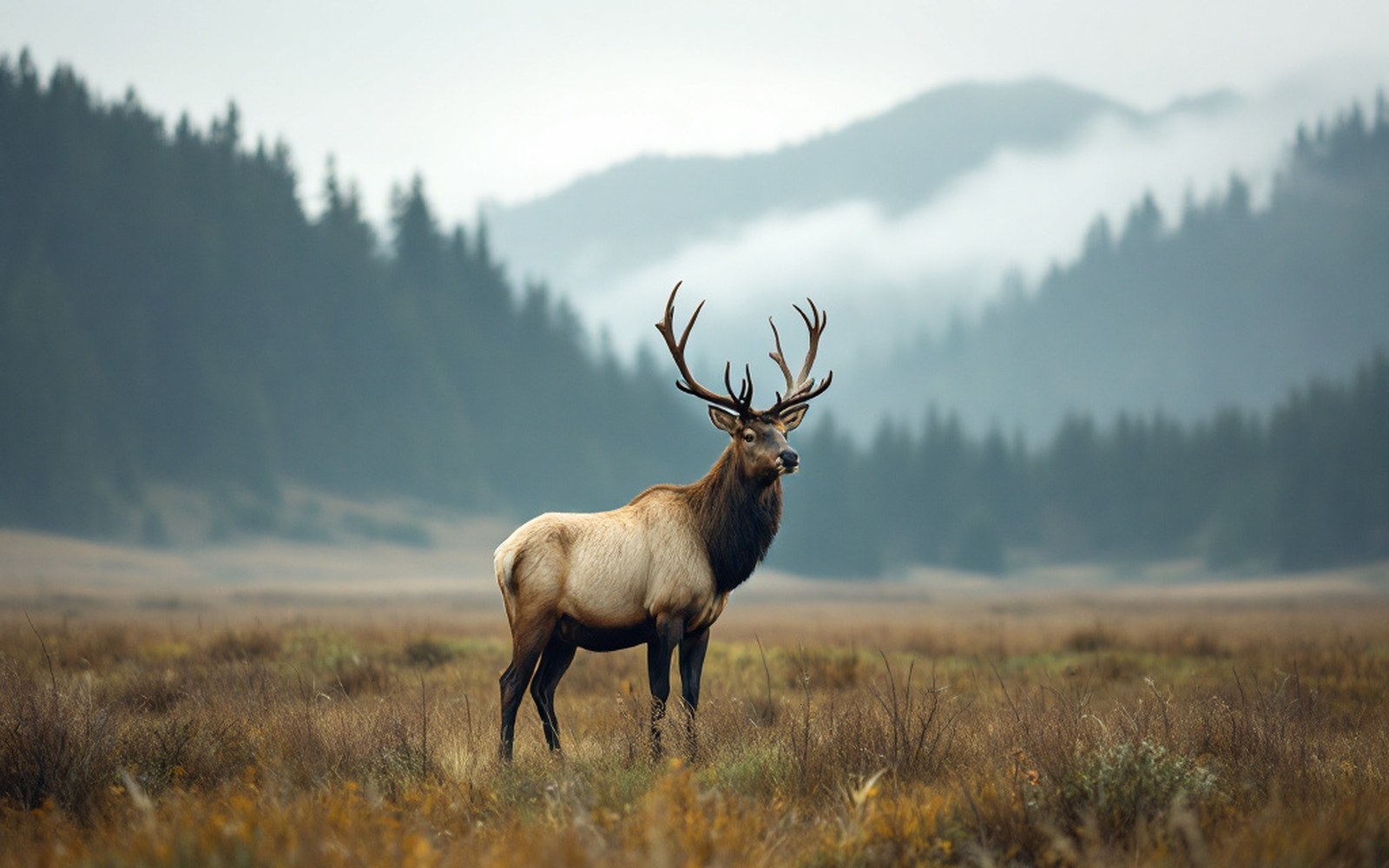
The eastern elk subspecies is extinct, so the animals now in Buchanan County are Rocky Mountain elk (Cervus canadensis nelsoni), a western subspecies considered the most appropriate surrogate. They are the same species, different subspecies — a distinction that matters taxonomically but not practically when you are watching a six-hundred-pound bull move through mist across a reclaimed coal bench at dawn.
Chronology
Late 1700selk extirpated from Virginia
1977Surface Mining Control and Reclamation Act passed, requiring reclamation of mine land
2012reintroduction begins in Buchanan County in partnership with the Rocky Mountain Elk Foundation and coal companies
2020roughly 250 animals released; population self-sustaining
The herd has attracted attention for reasons beyond ecology. Buchanan County is one of the poorest counties in Virginia by median household income, and wildlife tourism centered on a large, visible, charismatic animal has been consciously positioned as one component of economic diversification in a post-coal landscape. Viewing areas have been established on public land; the animals are easy to find in early morning and evening. That visibility is, again, a function of terrain — the mine benches are open, the elk are large, and there is nowhere for them to hide.
The reintroduction worked because the habitat existed. The habitat exists because the law required it. That chain of cause and effect, running from a 1977 statute through a century of extraction to a herd of elk grazing in fog, is the actual story of how a species comes back.