The bald eagle came back because one compound left: DDT's removal from American agriculture was what the bird needed, and the Chesapeake Bay proved it.
The recovery followed a ban on a chemical rather than any change in the birds.
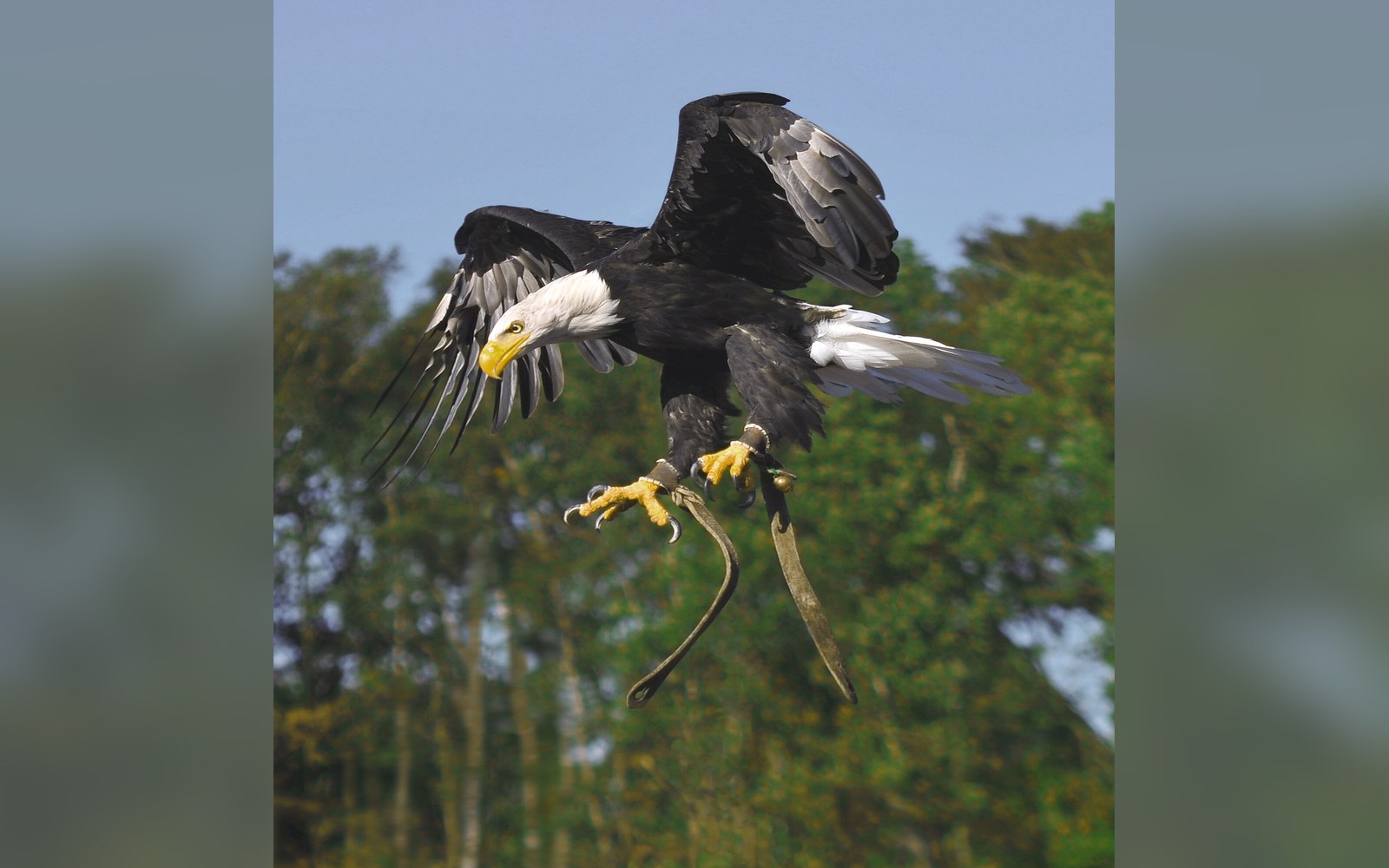
Photo: Bald eagle in a nosedive · Wikimedia Commons
A Hunter Hollowed Out
The bald eagle was never absent from Virginia's skies, but by the early 1960s what remained was a remnant so thin it barely registered as a population. A continental range had compressed into scattered pairs along the coasts and major rivers, and even those pairs were failing at the one task that keeps a species in the world. The eggs were hatching badly, or not hatching at all.
The mechanism was understood only after Rachel Carson's Silent Spring focused scientific attention on organochlorine pesticides in 1962. DDT, sprayed across American farmland and marshland in vast quantities since the 1940s, was moving up the food chain. Eagles ate fish; fish carried the compound in their tissues; the compound accumulated in the eagle's fat and, critically, interfered with calcium metabolism. The shells the females produced were too thin to survive incubation. A bird that can live thirty years and does not reach sexual maturity until its fourth or fifth was being removed from the breeding population one clutch at a time, and the arithmetic ran in one direction only.
A substitute cliff.
The Chesapeake Bay drainage was the worst possible theater for this kind of contamination. Agriculture ran to the water's edge across the Eastern Shore and the broad peninsulas between the tidal rivers. DDT and related compounds passed through the watershed into the Bay and into every fish that fed in it. The eagles that nested in the loblolly pines above the tidal marshes were eating from a chemically compromised pantry every day of the breeding season.
What the Ban Did
The United States banned DDT in 1972. The decision followed the EPA's own review, which had accumulated enough evidence to conclude that the compound's persistence and bioaccumulation posed unacceptable risks. The ban did not clean the environment overnight — DDT and its breakdown products remain detectable in Bay sediments to this day — but it stopped the flow of new contamination at scale, and the existing burden diluted across the decades that followed.
Timeline of the recovery
Chronology
1940Bald and Golden Eagle Protection Act prohibits killing or disturbing eagles, regardless of later listing status
1962Silent Spring published; scientific attention turns to organochlorine effects on reproduction
1972EPA bans DDT; contamination of watershed begins slow decline
1978Bald eagle listed as endangered in most of the lower 48 states (threatened in a few northern states); reclassified as threatened in 1995
1980s–90sNest productivity improves across Chesapeake tidal tributaries; monitoring records show rising fledgling counts
2007Formally delisted under the Endangered Species Act, June 28
Eagles responded. They did not respond immediately: a bird that spent the 1950s and 1960s failing to reproduce was also not replacing its adult breeders, so the population had a structural deficit built in. But through the late 1970s and into the 1980s, productivity figures from monitoring stations along the Potomac and the Rappahannock began to improve. Shells thickened. Chicks fledged. Young birds — the mottled brown birds that won't show white heads and tails until their fourth or fifth year — began appearing in greater numbers.
The Virginia Department of Wildlife Resources and its predecessor agencies tracked these changes with nest surveys that have continued across decades, building one of the more complete long-term records of raptor recovery in the eastern United States. By the 1990s, the Bay's eagle population was not merely recovering; it was growing at a rate that began to reshape expectations of what a recovered population might look like.
Supplemental programs helped at the margins. Captive-rearing and hacking — placing young birds at towers and allowing them to fledge into the wild — added birds during the years when natural productivity was still sub-replacement. But the fundamental driver was the chemistry: remove the suppressor, and a long-lived, territorially faithful bird with strong natal site fidelity will rebuild its numbers if the habitat is there. The Bay's combination of open water, productive fish stocks, and tall pines above undisturbed shoreline was exactly the habitat.
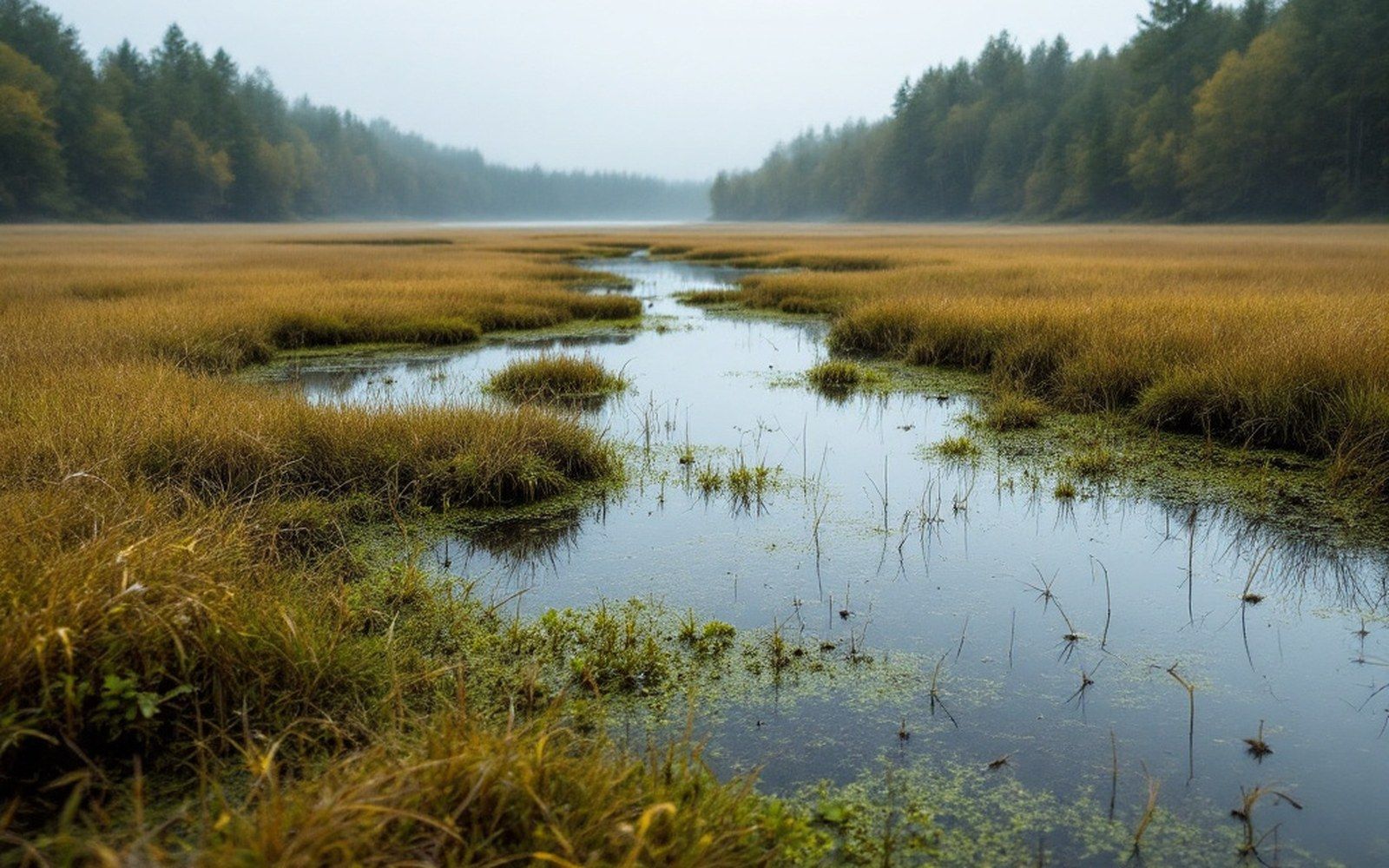
Marsh like this is a fuel stop. The birds using it this week are a thousand miles away by the next one.
The Chesapeake as Recovery Engine
The Chesapeake Bay Program, the multi-state, multi-agency partnership that coordinates restoration across the watershed, has documented what is now one of the densest concentrations of nesting bald eagles in the lower forty-eight states outside Alaska. Nesting pairs along the Bay's tidal tributaries — the Potomac, the Rappahannock, the York, the James — number in the hundreds. Winter surveys have counted well over two thousand individual birds roosting in the watershed during cold months, when eagles from further north move into the Bay's relatively ice-free waters.
This density is ecologically meaningful in ways that extend beyond the eagle itself. An apex predator present at these numbers influences fish behavior, waterfowl distribution, and scavenging networks. Eagles on the Bay are not a relict or an artifact; they are a functioning part of a system that spent a generation learning to do without them.
The formal recognition of that recovery came on June 28, 2007, when the bald eagle was removed from the federal list of threatened and endangered species under the Endangered Species Act. The listing had been in place since 1978 — the threatened designation replaced an earlier endangered listing — and the delisting followed criteria that included stable or increasing population trends, adequate habitat protection, and the absence of the threats that originally caused the decline. The recovery had been documented, the documentation had been reviewed, and the decision held.
What delisting means
Delisting
removal from the federal threatened and endangered species list; does not end all legal protections
Bald and Golden Eagle Protection Act
the 1940 statute that remains in force after delisting and prohibits nest disturbance and harassment
Hacking
a reintroduction technique: young birds placed at artificial towers and allowed to fledge into the wild
Shell-thinning
the reproductive mechanism by which DDT suppressed raptor populations; calcium metabolism disruption reduces eggshell thickness
What protected the bird after delisting was not the Endangered Species Act but other statutes already on the books: the Bald and Golden Eagle Protection Act of 1940, which prohibits disturbing nests or harassing individuals, remains in force regardless of listing status. The eagle did not lose its legal protection; it gained a different kind, one appropriate to a species no longer in crisis.
What Remains on the Shoreline
Walk any tidal creek on Virginia's Northern Neck or Middle Peninsula in early spring and the odds are high that you will see a bald eagle before you see most other raptors. The large, untidy stick nests in the forks of loblolly pines are visible from a distance. Adults call in flight — a series of thin, descending whistles that sound improbably small for a bird with a seven-foot wingspan. Juveniles, brown-headed and streaked, are everywhere in winter.
The recovery measures something real about what a policy decision in 1972 produced. One compound, banned, released a biological system from a particular kind of pressure, and the system — given time, given the continued existence of shoreline forests and productive water — found its way back. The Chesapeake Bay is the proof of concept, written in nesting pairs along two hundred miles of tidal rivers, and the birds are not subtle about it.